Mastering Enterprise Software Delivery Through Hands-On Modern Cloud Practices
Introduction
Rapid delivery cycles demand resilient operational architectures that eliminate engineering friction completely. Because competitive markets penalize slow release schedules, innovative teams actively automate manual workloads across their entire software delivery pipeline.
Focused laboratory environments empower technical staff to master automated provisioning and production troubleshooting directly. Consequently, organizations achieve predictable releases while maintaining uninterrupted system availability.
Navigating Modern Engineering Shifts
Software development teams now bridge traditional operational divides by applying continuous automation across every release stage. Because collaboration replaces isolated departmental handoffs, technical contributors resolve delivery bottlenecks before code reaches production environments.
Furthermore, forward-thinking enterprises report significantly faster recovery periods and drastically reduced failure rates. When cross-functional teams embrace unified deployment principles, engineering throughput accelerates across the entire corporate portfolio.
Essential Building Blocks of Production Environments
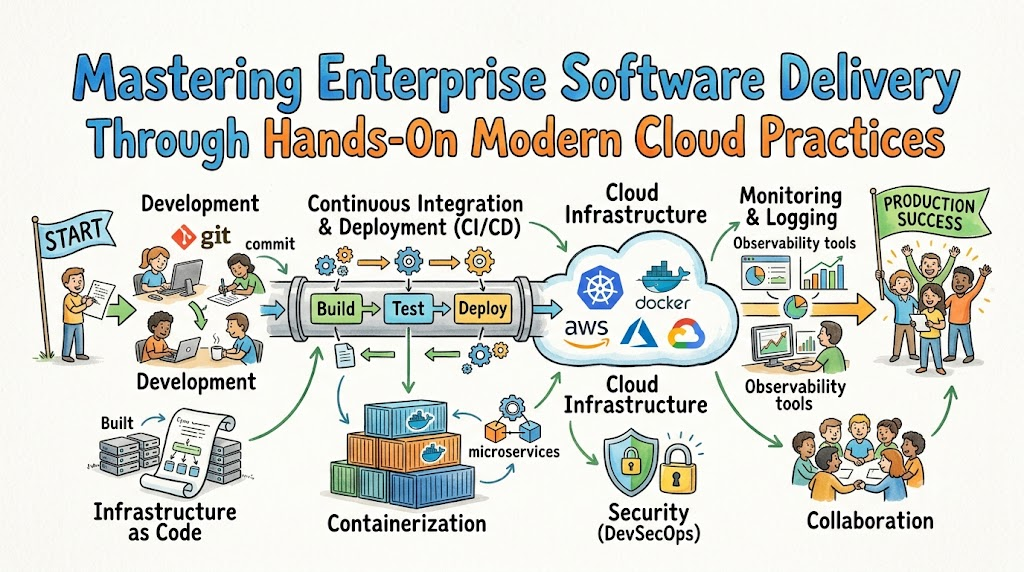
High-performing infrastructure environments integrate several complementary technologies that manage code promotion smoothly. As a result, engineering groups connect source code management, continuous integration, and infrastructure provisioning into a single, cohesive workflow.
- Central Repositories: Unified Git systems that track all software components, manifests, and system configurations.
- Continuous Integration Engines: Automated testing frameworks that build and validate incoming code commits instantly.
- Deployment Automation: Robust release mechanisms that push validated artifacts through staging environments safely.
- Deep Telemetry Systems: Centralized logging, distributed tracing, and system metrics that reveal operational health proactively.
Streamlining Software Delivery Pipelines
Continuous integration and automated delivery mechanisms establish the core engine of resilient digital organizations. Therefore, engineers validate individual code changes against rigorous unit tests rather than coordinating risky bulk updates.
In addition, advanced rollout patterns like canary releases and blue-green deployments shield end-users from unexpected application defects. By letting automated tools handle artifact delivery, development specialists focus entirely on designing high-impact business features.
Treating Infrastructure as Versioned Code
Declarative code structures allow infrastructure engineers to manage computational capacity just like application software. Operations teams therefore define virtual networks, database instances, and server clusters inside standard version-controlled repositories.
By employing tools such as Terraform alongside Ansible, technical departments eliminate configuration drift across environments. Consequently, system administrators bypass manual management consoles and reproduce identical infrastructure configurations on demand.
Orchestrating Microservices with Kubernetes
Container images bundle microservices with their dedicated runtime dependencies, removing environmental inconsistencies across development machines and production instances. Thus, engineering teams execute applications predictably regardless of the underlying hosting platform.
Completing comprehensive Kubernetes Training China enables engineers to design and govern resilient clustered workloads successfully. Container orchestrators automatically manage pod auto-scaling, dynamic storage allocation, self-healing restarts, and zero-downtime rolling updates.
Engineering High System Reliability
Site Reliability Engineering translates core programming concepts directly into complex infrastructure operations. Technical teams build fault-tolerant distributed platforms while managing error budgets, service-level targets, and operational overhead systematically.
Enrolling in specialized SRE Training China equips technical specialists to safeguard distributed applications against unexpected service disruptions. Moreover, engineers develop actionable telemetry alerts and automated incident response scripts that protect system uptime.
Integrating Defense Measures into Pipelines
Fast release cadences demand automated vulnerability detection rather than delayed security evaluations right before launch. Progressive technology organizations introduce static analysis, container image inspection, and identity policies directly inside automated pipelines.
Participants completing dedicated DevSecOps Training China learn to apply automated vulnerability audits and zero-trust controls across every build. As a consequence, development teams eliminate security vulnerabilities long before artifacts enter active production environments.
Architecting Scalable Cloud Ecosystems
Modern enterprises rely on scalable cloud computing platforms to support dynamic application traffic worldwide. However, managing multi-cloud footprints requires technical expertise across cloud networking, access management, dynamic scaling, and expenditure control.
Undertaking structured Cloud Computing Training China empowers engineers to configure AWS, Microsoft Azure, and Google Cloud environments effectively. Teams build highly durable multi-region architectures that handle large customer spikes without performance degradation.
Empowering Developers Through Internal Platforms
Platform engineering consolidates complex infrastructure technologies into intuitive self-service interfaces for application developers. Because product engineers provision infrastructure independently, cross-functional delivery velocity accelerates without requiring administrative interventions.
Through structured Platform Engineering Training China, infrastructure specialists build reliable deployment templates, automated pipelines, and internal golden paths. Developer satisfaction consequently improves while organizational governance, compliance, and auditing policies remain strictly enforced.
Scaling Machine Learning Operations
Predictive artificial intelligence systems require automated deployment pipelines because real-world data distributions constantly evolve. Data science teams therefore require dedicated automation frameworks that match established software engineering standards.
Targeted MLOps Training China trains engineers to package and deploy analytical models across scalable container platforms. Teams automate data ingestion, tracking pipelines, model artifact validation, and real-time inference monitoring smoothly.
Structural Progression for Technical Excellence
Acquiring operational competency requires an intentional, step-by-step learning progression rather than attempting advanced orchestration tools prematurely. Aspiring engineers should follow a clear path to build foundational confidence before deploying complex distributed environments.
| Skill Level | Core Discipline | Essential Toolsets & Capabilities |
| Stage 1: Fundamentals | Shell Scripting & Systems | Bash, Python, Linux Internals, Network Protocols |
| Stage 2: Automation | Build Pipelines & Images | Git, GitHub Actions, Docker, Container Builds |
| Stage 3: Infrastructure | Declarative Provisioning | Terraform, Ansible, Identity Governance |
| Stage 4: Orchestration | Clustered Deployments | Kubernetes, Helm Charts, GitOps Tools |
| Stage 5: Reliability | Monitoring & Protection | Prometheus, Grafana, OpenTelemetry, Policy Automation |
Enterprise Workforces Versus Independent Study
Solitary online tutorials typically supply theoretical concepts that struggle against messy enterprise application realities. Conversely, corporate training initiatives focus directly on company-wide architecture, existing technology stacks, and organizational workflows.
Enlisting your workforce in tailored Corporate DevOps Training China builds unified operational competencies across distributed development squads. As a direct result, organizations break down technical silos, shorten developer onboarding, and accelerate complex modernization initiatives.
Accelerating Transformation with Expert Consulting
Organizations frequently encounter delivery delays, fragile build workflows, and persistent configuration drift within legacy environments. Outside technical leadership helps identify systemic engineering bottlenecks and guides the adoption of modern delivery standards.
Partnering with professional DevOps Consulting China advisors delivers objective architectural audits alongside practical migration roadmaps. Enterprises consequently modernize legacy delivery workflows smoothly while avoiding costly architectural trial-and-error mistakes.
Selecting Comprehensive Learning Tracks
Evaluating career development programs requires prioritizing real-world laboratory exercises over passive conceptual slide presentations. Candidates should select comprehensive curricula that feature authentic troubleshooting exercises and complete continuous delivery pipelines.
Moreover, earning verified DevOps Certification China credentials presents verifiable proof of practical platform engineering abilities. Enrolling in focused DevOps Training China programs equips engineers with the actionable proficiencies demanded by premier technology organizations.
Typical Hurdles in Modern Skill Building
A recurring mistake among technical professionals involves collecting multiple credentials without mastering fundamental system administration concepts. For instance, launching Kubernetes clusters without understanding foundational Linux networking leads to fragile configurations during outages.
Furthermore, learners often overlook continuous testing automation, application monitoring, and team collaboration practices. Because modern delivery balances operational culture with automation tooling, focusing exclusively on syntax leaves major delivery problems unsolved.
Critical Operational Skills for Resilient Production
Production systems require rapid diagnostic capabilities and deep operational visibility during unexpected system interruptions. Engineering directors naturally favor technical candidates who demonstrate decisive troubleshooting skills over surface-level tool exposure.
- Isolating distributed network latency bottlenecks and optimizing application ingress routing.
- Writing modular, declarative infrastructure definitions using automated syntax linting.
- Hardening lightweight container images to shrink overall system attack surfaces.
- Configuring distributed tracing frameworks to detect cross-microservice communication failures.
Expanding Engineering Roles Across Regional Markets
Enterprises across China are aggressively modernizing legacy digital platforms, which fuels persistent demand for automation specialists. As a result, systems architects, pipeline engineers, and reliability specialists discover rewarding career trajectories across multiple technical sectors.
- Cloud Automation Specialist: Constructs and supervises resilient continuous integration pipelines and server provisioning systems.
- Site Reliability Engineer: Protects application health, defines operational metrics, and automates disaster recovery workflows.
- Platform Operations Engineer: Builds internal self-service developer consoles that eliminate cross-team delivery dependencies.
- Cloud Infrastructure Architect: Directs organizational migrations toward flexible, highly available public and hybrid cloud environments.
The Decisive Value of Immersive Practice
Real operational proficiency never develops through passive reading or recorded lecture videos alone. On the contrary, genuine engineering confidence crystallizes when practitioners repair failing pipelines, configure networks, and debug broken orchestration deployments.
Interactive lab environments place students directly inside authentic infrastructure challenges and realistic production configurations. Learners thus build the practical instincts needed to safeguard mission-critical delivery environments under pressure.
Practical Delivery Mastery and Career Advancement
Structured curriculum tracks connect conceptual fundamentals directly to real-world cloud deployment execution. Guided by seasoned industry mentors, engineers complete intensive laboratories covering infrastructure orchestration, automated pipelines, container fleets, and cloud systems.
Additionally, training modules continuously integrate modern delivery practices, enabling professionals to master complex observability patterns and container environments. Participants develop verified engineering skills that drive digital transformation and expand long-term career growth.
Frequently Asked Questions
- Which technical foundations help candidates excel in modern infrastructure courses?Engineers benefit significantly from understanding command-line Linux navigation, standard operating system concepts, and basic scripting languages.
- How do dedicated hands-on labs simulate genuine production challenges?Learners construct multi-node container clusters, build automated pipelines, and configure real cloud resources inside dedicated sandbox environments.
- Why do modern cloud architectures require specialized orchestration skills?Enterprises deploy microservices across distributed container networks, making automated container orchestration vital for system performance and scalability.
- What core difference separates reliability engineering from legacy system administration?Reliability engineering applies software programming techniques directly to operations problems, replacing manual maintenance tasks with automated software routines.
- How does early automated testing protect enterprise deployment pipelines?Embedding vulnerability scans directly within continuous integration catches bugs early, lowering remediation expenses and eliminating security risks.
- Can technical organizations adapt enterprise curricula to match proprietary architectures?Corporate training programs incorporate specific organizational toolsets, internal frameworks, and corporate digital objectives into the course syllabus.
- What practical benefits do verified professional credentials offer candidates?Industry credentials validate hands-on technical competence, providing hiring committees with concrete evidence of an engineer’s operational ability.
- How do internal developer platforms accelerate software delivery cycles?Platform engineering establishes automated self-service paths that eliminate cross-team dependencies, enabling application engineers to deploy software independently.
- Why does continuous deployment outperform periodic manual release windows?Automated continuous delivery detects bugs immediately across small updates, preventing massive integration conflicts from contaminating active production servers.
- What role does automation play within machine learning deployment workflows?It streamlines feature preparation, automated model evaluation, deployment configurations, and ongoing inference monitoring across production clusters.
Final Thoughts
Dynamic infrastructure practices redefine enterprise software engineering by eliminating operational friction and accelerating feature delivery worldwide. Mastering container orchestration, declarative infrastructure, automated security testing, and platform reliability remains paramount for technical leaders.
Leave a Reply