Accelerating Career Trajectories With AWS Certified DevOps Engineer Professional Accreditation
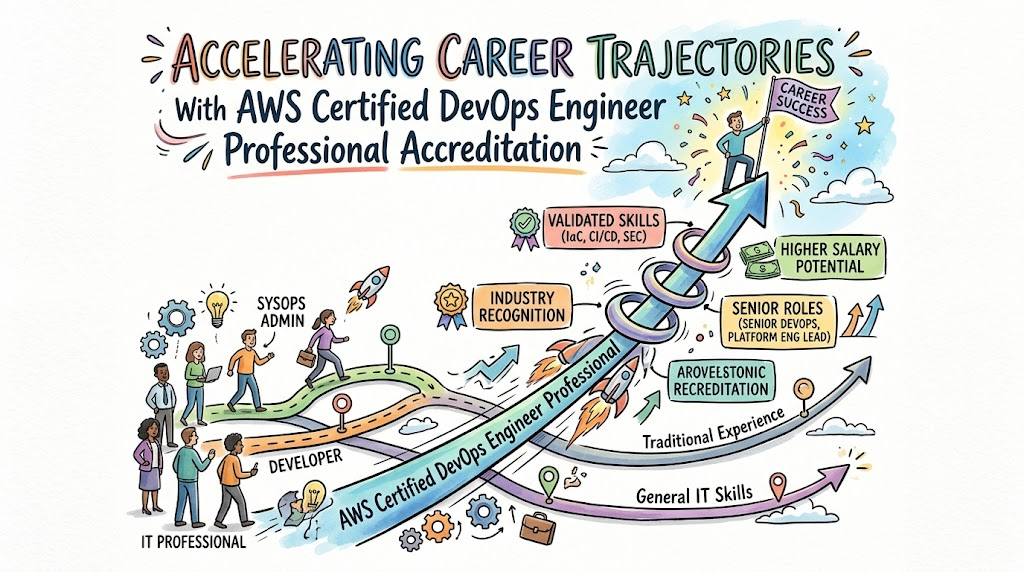
Modern software organizations demand practitioners who build robust delivery pipelines while preserving system reliability. Furthermore, distributed architectures compel technology leaders to hire engineers who master cloud infrastructure automation under demanding production constraints. Consequently, this strategic roadmap inspects the AWS Certified DevOps Engineer Professional pathway hosted through DevOpsSchool. Software practitioners, platform specialists, and engineering managers gain actionable perspectives on exam expectations, industry applications, and progressive career tracks across global engineering enterprises.
Operational Scope of the AWS Certified DevOps Engineer Professional Credential
The AWS Certified DevOps Engineer Professional qualification confirms an engineer’s capacity to design, deploy, maintain, and safeguard mission-critical systems across distributed cloud footprints. Rather than evaluating passive trivia, the assessment tests hands-on architectural problem-solving across dynamic infrastructure provisioning, automated CI/CD pipelines, observability frameworks, and automated incident recovery.
Engineering departments have abandoned slow manual interventions and fragmented maintenance scripts. Instead, contemporary systems rely on declarative code, immutable machine images, continuous automated verification, and proactive telemetry.
This certification verifies that an engineer builds cloud environments that withstand sudden outages, enforce security baselines automatically, and accelerate deployment frequency without manual gates.
Target Engineering Profiles for AWS Certified DevOps Engineer Professional
Senior cloud operators, platform builders, Site Reliability Engineers, and infrastructure architects gain direct value from this credential. Additionally, backend software developers transitioning into platform engineering, security teams automating compliance controls, and technical leads seeking delivery acceleration benefit immensely.
Practitioners who operate production workloads on AWS across multiple years will recognize familiar operational challenges within the curriculum. Furthermore, technical managers master repeatable cloud architectural blueprints that eliminate technical debt across expanding engineering groups.
Engineers across global technology centers—including fast-scaling enterprises and global capability hubs in India—leverage this credential to substantiate technical depth. Technology recruiters prioritize certified candidates when staffing mission-critical platform reliability assignments.
Strategic Value and Career Longevity
Public cloud infrastructure consumption continues its aggressive expansion across global markets, driving sustained demand for senior automation talent. Because certified engineers optimize delivery speed and reduce cloud operational expenses, forward-thinking organizations provide substantial compensation packages to retain them.
Tools and user interfaces update continuously, yet fundamental automation methodologies retain long-term value. Principles such as declarative deployments, minimal-privilege security boundaries, event-triggered telemetry, and automated remediation remain indispensable throughout an engineer’s career. Earning this credential establishes resilient architectural thinking over ephemeral scripting habits.
The overall professional return extends beyond salary enhancements. Engineers implement reliable zero-downtime releases and automated policy engines, eliminating disruptive off-hours emergency pages. Investing effort into this mastery establishes long-term technical authority across evolving enterprise environments.
Certification Framework and Assessment Blueprint
The AWS Certified DevOps Engineer Professional curriculum confirms end-to-end expertise spanning automated pipelines, fleet-wide configuration, continuous monitoring, security governance, and multi-region resilience. The credential sits at the professional level, constituting the pinnacle of general AWS operational verification.
The official evaluation presents complex operational scenarios that replicate real production failures and delivery bottlenecks. Candidates analyze design trade-offs, correct subtle permission and networking bugs, and choose cost-effective automation architectures while managing time pressure.
Securing the credential confirms total ownership of the continuous release lifecycle. It certifies that an engineer oversees software systems from initial git commits and automated testing gates through canary rollouts, live tracing, and dynamic fleet autoscaling.
Institutional Advantages of DevOpsSchool
DevOpsSchool maintains an established position as an elite training institute for platform engineering, having guided more than 40,000 students and supported corporate engineering teams internationally. Principal engineers who manage production environments daily design and deliver every instructional module.
Learners work through real-world deployment labs, system crash simulations, and complete automation pipelines instead of passive lectures. The institution supplies persistent access to proprietary lab codebases, session archives, practical interview preparation modules, and an active peer network of cloud practitioners.
Global organizations partner with this platform to upgrade technical teams because the curriculum focuses directly on verifiable business outcomes. By solving realistic failure scenarios and conducting thorough design reviews, students develop the practical confidence required to govern mission-critical enterprise systems.
Progressive Tier Structure and Certification Hierarchy
Plotting an effective certification pathway requires understanding the functional relationships between foundational, associate, and professional tiers. While entry-level tiers verify baseline terminology, professional tracks demand decisive hands-on command of enterprise systems.
Specialized disciplines—including site reliability, security automation, developer platforms, cloud economics, and applied machine learning—expand directly from the core capabilities assessed at the professional level.
[Foundational / Associate Baseline]
       │
       ▼
[AWS Certified DevOps Engineer Professional]
       │
       ├─────────────────┼─────────────────┐
       ▼                 ▼                 ▼
[Security Engineering]  [SRE & Platform]   [FinOps & AIOps]
Attaining the DevOps Professional milestone anchors an engineer’s technical profile, unlocking high-level leadership opportunities across enterprise cloud engineering.
Certification Progression Matrix
| Track | Level | Who it’s for | Prerequisites | Skills Covered | Recommended Order |
| Cloud Foundation | Foundational | Beginners, Managers | Basic IT concepts | Cloud basics, global infra, billing | 1 |
| Systems Administration | Associate | SysAdmins, Junior Ops | Linux, networking | EC2, VPC, IAM, basic storage | 2 |
| Cloud Development | Associate | Software Developers | Programming, API basics | Serverless, DynamoDB, SDKs | 2 |
| Solutions Architecture | Associate | Solutions Architects | System design basics | Multi-tier architecture, HA/DR | 2 |
| DevOps Engineering | Professional | Senior DevOps, SREs, Platform Leads | Associate level or 2+ yrs AWS experience | CI/CD, IaC, governance, telemetry | 3 |
| Solutions Architecture | Professional | Principal Architects | Associate SA or 3+ yrs AWS experience | Complex migrations, multi-account orgs | 4 |
| Cloud Security | Specialty | Security Engineers | Networking, IAM basics | KMS, GuardDuty, incident response | 4 |
| Advanced Networking | Specialty | Network Engineers | Hybrid connectivity | Direct Connect, Transit Gateway | 4 |
Comprehensive Breakdown: AWS Certified DevOps Engineer Professional
AWS Certified DevOps Engineer Professional – Core Professional Track
What it is
This credential validates an engineer’s ability to automate the provisioning, testing, deployment, scaling, and daily operations of enterprise workloads on AWS. It confirms thorough command over multi-branch delivery pipelines, automated security compliance, and comprehensive distributed telemetry.
Who should take it
DevOps engineers, systems administrators, cloud architects, and site reliability practitioners who possess two or more years of practical experience running production workloads on AWS should pursue this program.
Skills you’ll gain
- Building continuous delivery workflows through CodePipeline, CodeBuild, and CodeDeploy.
- Writing modular infrastructure as code utilizing CloudFormation, AWS CDK, and Terraform.
- Triggering automated event-driven remediation workflows with EventBridge, Lambda, and Systems Manager.
- Rolling out zero-downtime updates using blue/green, canary, and rolling deployment patterns.
- Consolidating enterprise logging, distributed request tracing, and custom metric collection through CloudWatch and X-Ray.
- Establishing automated operational guardrails, compliance rules, and drift detection via AWS Config and Service Control Policies.
Real-world projects you should be able to do
- Construct a cross-region disaster recovery mechanism that restores application state within a fifteen-minute window.
- Implement a multi-account CI/CD deployment platform that releases microservices across development, staging, and production tiers.
- Deploy an automated compliance monitor that terminates non-compliant resources and notifies on-call teams immediately.
- Configure auto-scaling container workloads across Amazon ECS and EKS using horizontal pod autoscaling and canary routing.
Preparation plan
- 7–14 Days Plan: Dedicate 8 hours daily to examining official whitepapers, studying core domain outlines, reviewing practice scenario questions, and validating unfamiliar service integrations inside personal sandbox accounts.
- 30 Days Plan: Invest 2 hours every day to complete one exam domain every five days, setting aside weekends to build end-to-end automation pipelines, multi-account organizations, and timed diagnostic quizzes.
- 60 Days Plan: Commit 1 to 2 hours each day starting with architecture fundamentals, spending 30 days building automation workflows and troubleshooting realistic failure states, before finishing with full-length practice tests.
Common mistakes
- Memorizing static practice dumps instead of building actual configurations through the CLI and management console.
- Overlooking cross-account permissions inside AWS Organizations and Service Control Policy logic.
- Skipping lifecycle event hooks and rollback scripts inside CodeDeploy deployment specifications.
- Skimming over CloudWatch metric filter syntax, custom dimension tracking, and alerting configurations.
Best next certification after this
- Same-track option: AWS Certified Solutions Architect Professional
- Cross-track option: AWS Certified Security – Specialty
- Leadership option: Certified Information Systems Security Manager or AWS Cloud Digital Leader for Executives
Selecting Your Technical Specialization
DevOps Path
The dedicated DevOps discipline emphasizes deployment velocity, build reliability, and continuous iteration. Engineers construct automated delivery pipelines, eliminate error-prone manual steps, and standardize container environments. Consequently, this path sharpens automated testing, release coordination, and zero-downtime updates, enabling software teams to release software changes rapidly and predictably.
DevSecOps Path
The DevSecOps discipline injects programmatic security validation directly into software release cycles. Engineers integrate static application security testing, container image vulnerability scanning, dependency tracking, and dynamic policy verification into pipelines. As a result, teams resolve security vulnerabilities early, maintaining strict enterprise compliance and regulatory standards without delaying production deployments.
SRE Path
Site Reliability Engineering safeguards production availability while accommodating rapid feature releases. Engineers establish service-level indicators, service-level objectives, error budgets, and automated incident triage workflows. Furthermore, SREs configure distributed tracing, self-healing automations, and chaos experiments to ensure systems absorb localized infrastructure failures smoothly.
AIOps Path
The AIOps specialization deploys machine learning algorithms to manage enterprise IT operations. Engineers configure analytical systems to process telemetry streams, detect operational anomalies, anticipate capacity bottlenecks, and isolate root causes across microservices architectures. Therefore, engineering departments minimize incident detection windows and resolve outages rapidly.
MLOps Path
The MLOps discipline operationalizes machine learning systems from experimental training to live inference. Engineers create automated data preparation workflows, evaluate model performance drift, and deploy resilient model-serving endpoints on container fleets. By combining data science workflows with robust automation practices, organizations roll out model enhancements with strong observability and version control.
DataOps Path
DataOps applies continuous delivery principles to data platforms and analytics workflows. Engineers design automated data validation tests, coordinate schema migrations, and manage distributed extract-transform-load jobs. By managing data pipelines as versioned code, teams maintain accurate data warehouses, avoid data corruption, and provide reliable business intelligence.
FinOps Path
FinOps establishes financial transparency within cloud systems by connecting operational infrastructure choices directly to financial metrics. Practitioners dissect cost distribution, decommission unattached resources, optimize compute discount plans, and configure automated budget warnings. Consequently, engineering and finance teams collaborate to maximize business value from every cloud investment.
Role-Based Certification Alignment
| Role | Recommended Certifications |
| DevOps Engineer | AWS Certified DevOps Engineer Professional, AWS Certified SysOps Administrator Associate |
| SRE | AWS Certified DevOps Engineer Professional, AWS Certified Advanced Networking Specialty |
| Platform Engineer | AWS Certified DevOps Engineer Professional, AWS Certified Solutions Architect Professional |
| Cloud Engineer | AWS Certified Solutions Architect Associate, AWS Certified DevOps Engineer Professional |
| Security Engineer | AWS Certified Security Specialty, AWS Certified DevOps Engineer Professional |
| Data Engineer | AWS Certified Data Engineer Associate, AWS Certified DevOps Engineer Professional |
| FinOps Practitioner | AWS Certified Cloud Practitioner, AWS Certified DevOps Engineer Professional |
| Engineering Manager | AWS Certified Cloud Practitioner, AWS Certified DevOps Engineer Professional |
Post-Certification Career Pathways
Same Track Progression
Following the DevOps Professional credential, the AWS Certified Solutions Architect Professional offers the most strategic follow-up. While the DevOps track targets deployment pipelines and system automation, Solutions Architecture expands your expertise across global networking, complex cloud migrations, and hybrid infrastructure topologies. Holding both credentials validates an engineer’s authority to design cloud platforms from initial concept to daily operational management.
Cross-Track Expansion
Pursuing the AWS Certified Security Specialty significantly expands career opportunities. Enterprise organizations demand specialists who can enforce strict security postures without throttling delivery cadence. Validating advanced expertise across data encryption, key lifecycle management, federated access, and automated security incident response makes you indispensable in compliance-heavy industries like banking and healthcare.
Leadership & Management Track
Engineers moving toward director, platform head, or enterprise architect positions must master strategic IT governance. Augmenting your AWS technical certification with management credentials like TOGAF for enterprise frameworks or CISSP for cybersecurity leadership demonstrates that you align technical architecture with enterprise risk mitigation and business milestones.
Recommended Training Partners for AWS Certified DevOps Engineer Professional
Selecting a proven training platform accelerates your exam preparation and expands hands-on engineering capabilities. The following recognized providers deliver structured curriculums, interactive environments, and professional instruction:
DevOpsSchool delivers specialized platform training via live interactive bootcamps, hands-on production labs, and ongoing career guidance.
A Cloud Guru provides expansive on-demand video libraries alongside guided cloud sandbox environments.
Whizlabs supplies diagnostic practice question banks, scenario tests, and targeted cloud labs.
Udemy hosts user-rated independent video courses produced by experienced industry instructors.
Coursera partners with enterprise organizations and academic institutions to deliver structured cloud curriculums.
The Core Platform Authority
DevOpsSchool functions as a premier global academy dedicated to platform engineering, site reliability, continuous delivery, and cloud infrastructure architecture. Relying on an extensive roster of experienced senior instructors, the organization focuses relentlessly on operational mastery rather than surface-level test memorization.
Every instructional module ties architectural theory to terminal-based configuration tasks, live deployment pipelines, and troubleshooting labs that mirror enterprise production environments. Over the past decade, the platform has upskilled tens of thousands of software developers, system operators, and technical managers throughout India, North America, Europe, and the Asia-Pacific region.
Its structured coursework, comprehensive certification materials, dedicated mentorship spaces, and deep commitment to open-source workflows make it an invaluable destination for engineers seeking long-term professional growth in cloud engineering.
Frequently Asked Questions (General)
1. How difficult is the AWS Certified DevOps Engineer Professional examination?
Candidates regularly describe this exam as one of the most rigorous tests in the AWS catalog. Questions present extensive production scenarios covering deployment failures, multi-account IAM configurations, and disaster recovery. Thorough hands-on implementation experience is essential to evaluate architectural trade-offs under timed conditions.
2. How much preparation time does an experienced engineer need?
Engineers who work with AWS daily typically require 60 to 90 hours of focused study spread over eight to twelve weeks. Candidates lacking extensive automation experience should budget 120 hours or more to build and debug real architectures inside hands-on labs.
3. Are there mandatory prerequisites required before sitting for the exam?
AWS does not enforce mandatory prerequisite certifications before taking this test. However, attempting this challenging exam without mastering associate-level fundamentals or accumulating equivalent hands-on troubleshooting experience typically produces poor results.
4. What is the return on investment for earning this credential?
The tangible career return is significant for infrastructure professionals. Beyond qualifying you for senior roles commanding competitive enterprise salaries globally, the study process equips you to streamline deployments and eliminate repetitive manual maintenance tasks.
5. In what sequence should I pursue AWS certifications?
Candidates should begin with an associate certification—such as the Solutions Architect or SysOps Administrator Associate—to master basic services. After gaining comfort with core cloud concepts, transition directly into the AWS Certified DevOps Engineer Professional.
6. Does this certification focus exclusively on native AWS deployment tools?
While the test examines AWS services like CodePipeline, CodeBuild, CodeDeploy, and CloudFormation, the architectural principles transfer directly to open-source alternatives such as Jenkins, GitLab CI, GitHub Actions, and Terraform.
7. How long does the credential remain active after passing?
The credential remains valid for three years starting from your exam passing date. To retain your certified standing, you must pass the latest edition of the professional exam before the three-year window closes.
8. What score is required to pass the examination?
The scoring system uses a scaled range from 100 to 1,000 points, requiring a minimum passing score of 750. The test may include unscored experimental questions to calibrate future testing, though these do not influence your final calculation.
9. Can I take this certification exam from my home office?
Pearson VUE provides online proctored exams, letting you complete the test from a quiet office or private room. You must adhere to strict environmental requirements, including clearing your desk and maintaining webcam monitoring throughout the session.
10. How does this credential compare to Kubernetes or Linux certifications?
This exam tests cloud architecture, managed services, and multi-service automation, whereas Kubernetes and Linux certifications focus heavily on operating system internals and container runtime administration. Pairing both skill sets produces a well-rounded engineering background.
11. Does having this certification help non-cloud developers transition to DevOps?
Software engineers obtain a practical, structured framework for continuous deployment, declarative infrastructure, and system observability, significantly easing their transition into dedicated platform engineering roles.
12. Are hands-on labs necessary, or is theoretical study sufficient?
Book knowledge alone will not prepare you for this exam. The test scenarios examine subtle edge cases, permission errors, and service limits that candidates only master by assembling and fixing real cloud infrastructure.
FAQs on AWS Certified DevOps Engineer Professional
1. Which core AWS services receive the heaviest focus on this exam?
The assessment emphasizes tools supporting continuous integration, infrastructure automation, and system observability. Candidates must thoroughly understand CodePipeline, CodeDeploy, CodeBuild, CloudFormation, Systems Manager, Service Catalog, AWS Config, CloudWatch, EventBridge, IAM, and AWS Organizations. Mastering cross-account integrations across these tools remains vital.
2. How are deployment strategies like Blue/Green and Canary evaluated?
Scenarios evaluate zero-downtime deployment patterns for business-critical applications. You must select appropriate routing mechanisms using Route 53 DNS records, Application Load Balancer target groups, or CodeDeploy deployment parameters. Questions evaluate your handling of database migrations, session management, and instant automated rollbacks during deployment failures.
3. What level of scripting and coding knowledge is expected?
Candidates need not write complex algorithms, but they must parse and debug JSON and YAML templates used across CloudFormation, AWS Config rules, and IAM policies. Reading Python or Node.js logic inside Lambda automation functions and Systems Manager runbooks is crucial for evaluating automated remediation hooks.
4. How does the exam test multi-account governance?
The exam tests multi-account enterprise administration through AWS Organizations. You must configure Service Control Policies to enforce guardrails across organizational units, direct audit logs to centralized S3 buckets and CloudWatch groups, and automate baseline infrastructure rollouts with AWS Control Tower and CloudFormation StackSets.
5. What disaster recovery concepts are tested?
Scenarios assess your ability to implement automated backup, cross-region replication, and failover architectures. Candidates must know how to replicate Aurora and DynamoDB clusters across regions, schedule snapshot lifecycle rules through AWS Backup, and automate Route 53 health-check failover to satisfy strict operational recovery objectives.
6. How is infrastructure monitoring and auditing tested?
The test requires you to design centralized observability architectures across distributed applications. Questions explore CloudWatch metric filters, X-Ray tracing daemons on container tasks, VPC Flow Log security ingestion, and event-driven remediation pipelines powered by EventBridge and AWS Config rules.
7. How does this exam evaluate container management?
The test evaluates container orchestration using Amazon ECS, AWS Fargate, and Amazon ECR. You must demonstrate how to configure automated vulnerability scanning in ECR, manage task definition revision deployments, inject secrets safely via Systems Manager Parameter Store, and configure auto-scaling rules based on traffic patterns.
8. What is the best strategy for pacing during the exam?
You must answer 75 scenario-based questions in 180 minutes, leaving approximately 2.4 minutes per question. Read the final question sentence first to isolate the core problem, discard distractors immediately, flag uncertain questions for later review, and keep moving forward steadily.
Critical Assessment: Is AWS Certified DevOps Engineer Professional Worth It?
Committing several months of focused preparation toward the AWS Certified DevOps Engineer Professional credential demands significant personal dedication. It forces you to abandon isolated bash scripts in favor of designing resilient, enterprise-scale cloud systems.
Engineers seeking an effortless credential to decorate a resume will find this test challenging. The exam structure exposes superficial knowledge and rewards candidates who have debugged deployment pipelines, resolved complex IAM boundaries, and managed live cloud infrastructure.
Leave a Reply